Gul Cheena’s Journey Toward Stability
For years, Gul Cheena carried the burden of keeping her family together through hardship, displacement, and uncertainty.
At 45 years old, Gul Cheena is the mother of eight children — three sons and five daughters — living with a family of ten in Kabul. Originally returning from Pakistan six years ago, she remembers the difficult days when her family had no proper shelter and lived in a tent for nearly five years after coming back to Afghanistan.
“Life was very difficult when we returned,” she recalled. “We did not even have a proper house to live in.”
Today, although the family now lives in a modest mud house, daily life remains a struggle. Her husband, once a daily wage laborer, is now ill and unable to work, leaving the responsibility of supporting the household largely on the shoulders of Gul Cheena and her eldest son.
Her son had once hoped to continue his education, attending school for six years before financial hardship forced him to leave his studies behind and search for work to help support the family. Despite working long hours as a daily wage laborer, he earns only around 200 Afghanis per day — often not enough to meet the family’s basic needs.
For Gul Cheena, finding ways to provide food and essentials for her children has never been easy. In the past, she earned small amounts of income by tailoring clothes for neighbors. However, as more tailoring shops opened nearby, customers gradually stopped coming to her.

UNOPS Communications Officer interviewing Gul Cheena at a CRLP project site in Kabul city. @Rafiullah Hemat
“Before, women in the neighborhood used to bring clothes for sewing,” she said. “Now most people go to the shops, and I no longer receive much work.”
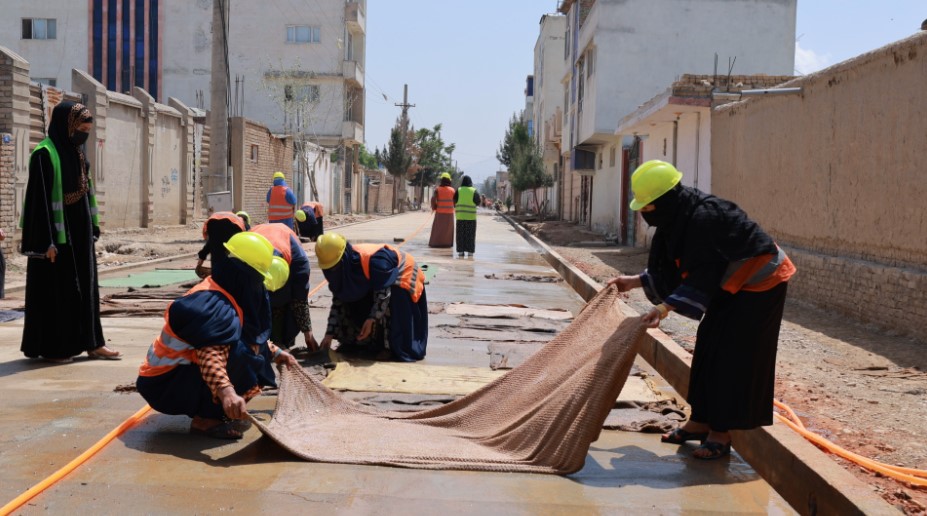
Recently, through the Community Resilience and Livelihoods Project (CRLP), implemented by UNOPS, Gul Cheena found a temporary employment opportunity, earning 450 AFN daily.
CRLP places a strong emphasis on the participation and inclusion of women, particularly those from vulnerable and female-headed households. By providing opportunities for women to engage in project activities, CRLP is helping to ensure that women can access employment, strengthen their livelihoods, and play an active role in supporting their families and communities.
“This work does not only help me earn money,” she explained. “Working alongside other women helps me feel less worried and stressed. Staying at home all the time made the problems feel heavier.”
The project has also created a sense of connection and support among women facing similar hardships, providing a space where they can work together while contributing to their households.
Through community-based livelihood and basic services activities, the Community Resilience and Livelihoods Project continues to support vulnerable families across Afghanistan, particularly women, by creating temporary employment opportunities that help restore dignity, resilience, and hope for a better future.
To date, the Community Resilience and Livelihoods Project (CRLP) has provided temporary employment opportunities to 79,779 women across Afghanistan. By creating income-generating opportunities for vulnerable women, including female-headed households, the project is helping families meet their basic needs, strengthen their resilience, and improve their livelihoods.
×
![]()