Building Community Assets
Building Community Assets, Building Opportunities: An Afghan Contractor’s Experience with CRLP
For Fazal Hadi Sahel, success is not measured only by the size of a contract or the number of projects his company has delivered. It is measured by the people who found work, the workers who learned a skill, and the communities that continue to benefit from what they built.

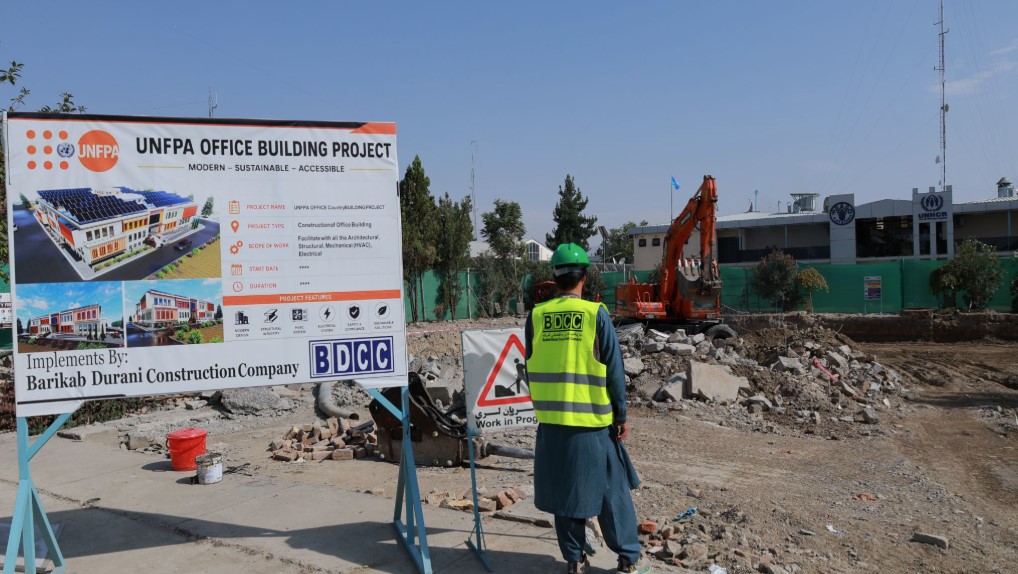
The Barikab Durani Construction Company is working on the building of the UNFPA office. @Rafiullah Hemat
Starting from almost nothing
Sahel has been working with his family’s construction company since 2004, when he joined his brother, Engineer Nasir, in establishing the business.
“We started working under very difficult conditions,” Sahel says. “At that time, the systems, staff and other resources that we have today did not exist. We did not even have an office. We started from the very beginning.”
The company operates under a construction licence and built experience through projects with the Government of Afghanistan. Over time, that experience opened doors to work with international organisations and United Nations agencies.
A new way of working with communities
When the Afghanistan Community Resilience and Livelihoods Project (CRLP) began, Sahel’s company was already an experienced contractor. But CRLP introduced a different dimension to its work: community-based implementation.
In a conventional construction project, much of the work can be managed directly between the contractor and the project team. Community-based projects require something more. Contractors must learn to work effectively with the local community as laborers on the project while maintaining quality, safety and accountability.
“The community has its own needs, perspectives and challenges. Therefore, we learned a lot from this project,” Sahel explained
Since 2023, the company has implemented four CRLP with UNOPS—two in Paghman and two in Kabul.
When a project creates more than a job
Afghanistan faces enormous economic challenges, making programmes that directly reach communities particularly important.
Sahel explained that on one project site, around 100 people can be employed each day. Some may continue working for three or four months.
“An unskilled worker may work with us on a project alongside a skilled worker. As they work together, the unskilled workers learn from the skilled worker. By the end of the project, some of them can become skilled workers themselves.”
For Sahel, skills are one of the most important forms of impact a project can leave behind.
The money travels beyond the worksite
Sahel also sees the economic impact extending beyond the people directly employed on a project.
“When people earn an income, they spend that money in the local community. They buy bread, food and other goods from local shops. So, the benefit reaches many other people as well.”
The impact begins at the worksite, but it does not necessarily end there. A worker receives an income. A family benefits. A local shopkeeper earns from increased demand. A worker learns a new skill. A community receives a facility that can continue serving people after the project ends. The result is a chain of opportunity.

Photo captured of Fazal Hadi Sahel working in his office. @Rafiullah Hemat
A mutually beneficial relationship
Today, Sahel’s company operates across several provinces and maintains project and site offices where it works.
Its operations span locations including Kabul, Kunduz, Mazar-e-Sharif, Kandahar, Nangarhar and Ghazni, with additional projects in other areas.
Sahel says some of the projects his company is currently implementing are worth around US$18 million, illustrating how far the company’s capacity has developed over the years.
Through 216 contractors across eight cities, CRLP has generated short term employment for 248,000 people from local communities. This workforce has helped build and improve roads, parks, drainage systems and other essential community facilities—creating income opportunities while strengthening access to basic services and helping cities respond to the growing needs of communities, including those welcoming returning families.
×
![]()