Water, Roads, and the Power of Hope
Water, Roads, and the Power of Hope
How Community Resilience Projects Are Rebuilding Lives in Afghanistan
For decades, communities in some of Afghanistan’s most remote areas have lived with hardship propagated by conflict and damaged infrastructure. This has quietly shaped every aspect of their lives—conflict over water for irrigation, isolation from markets, health services, and social networks. In Balalkhil village of Shirzad district, the mountainous valleys of Mandool in Nuristan, people have endured years of neglect due to the physical inaccessibility of the communities. Today, those same communities are writing new stories of resilience, revival of livelihoods and improved access to basic services through subprojects implemented by the Community Resilience and Livelihood Project (CRLP).
Water That Brought Peace Back to Balalkhil
For more than twenty years, farmers used spring water that flowed through Balalkhil village and into a weir for their irrigation—but it was never enough. Their old canal was damaged, impacting the flow of water and leaving nearly 360 acres of farmland dry. Plots closer to the weir were constantly waterlogged affecting agricultural productivity. Farmers tried everything—gunnysacks, stones, sand—to block the broken weir, but nothing worked. Failed harvests became routine, and disputes over water turned neighbors against each other.
“Some lands got water, others got nothing. When farmers around the weir finished irrigation and we reopened it, water spilled back into their fields. Their land became over-washed, and it caused many conflicts.”
When CRLP started its implementation in Balalkhil, the community prioritized rehabilitation of the canal. Through the Cash for Work activities, 165 community members worked for 15 days, earning 450 AFN per day. This did not only repair the damaged canal but put money directly in the pockets of vulnerable community members, enabling them to meet their basic needs and even purchase commercial seeds for their plots.
“Some families had no food reserves and relied entirely on the Cash for Work income to meet basic needs,” Khan Mohammad said. “This project helped them survive.”
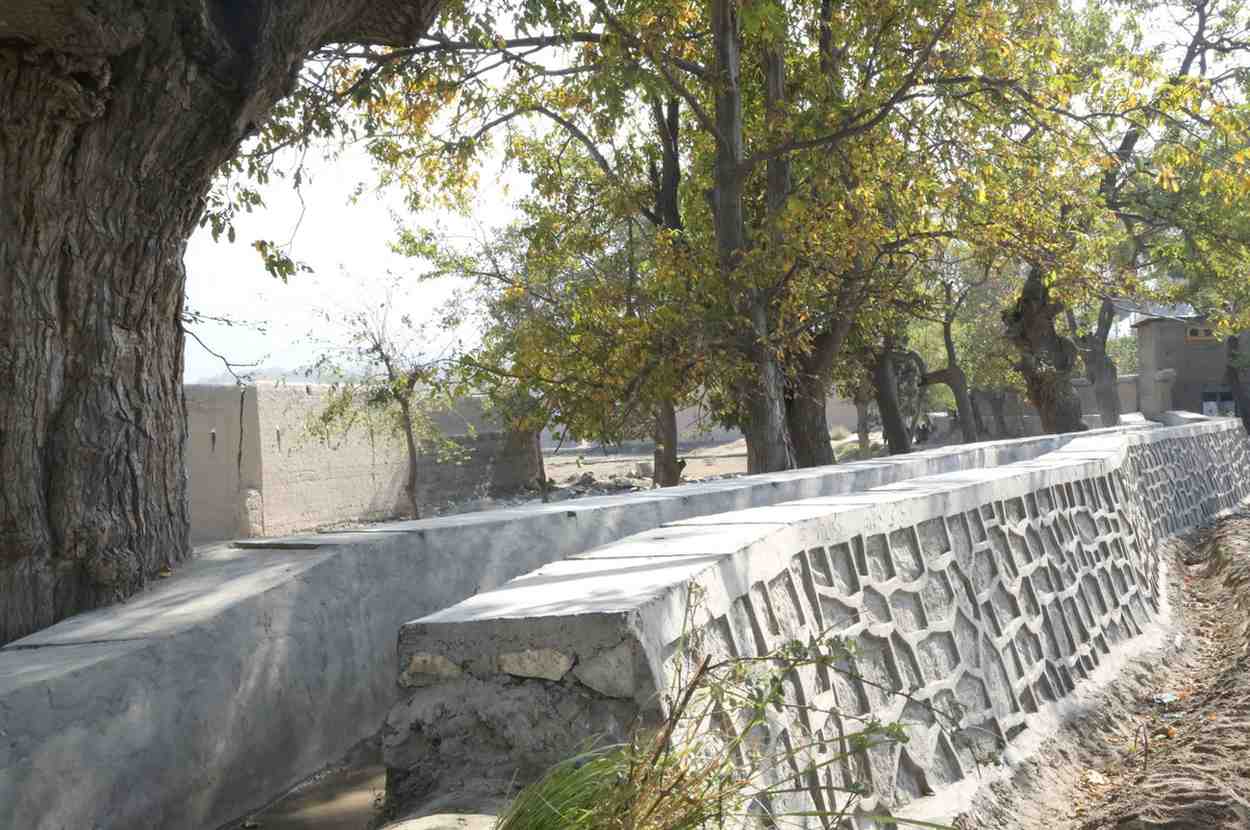
The project cleaned 1,992 meters of canal and lined 56 meters, restoring the flow of water to the fields. Today, up to 500 acres of farmland are now properly irrigated. Wheat, apples, maize, beans, tomatoes, and peanuts grow where dust once dominated.
The most powerful change is invisible:
“We are finally free from conflict,” Khan Mohammad said with relief.
Balalkhil’s land is green again, and so is its future. Though the community still dreams of clean drinking water, a clinic, and access to religious education for women, hope has been ignited.
“For twenty years, no one helped us,” Khan Mohammad reflected. “This project changed our lives.”

Photo: A completed 56-meter irrigation canal constructed under the Community Resilience and Livelihoods (CRL) Project in Balalkhil village, Shirzad District, Nangarhar Province. The canal enhances water management and supports agricultural production and livelihoods for local communities. © FP DACAAR
A Road That Reconnected Mandool to Life
High in the Mandool Mountains of Nuristan, the beautiful landscape existed side by side with extreme hardship. Crystal-clear water flowed through valleys untouched by development, while communities lived completely cut off—no roads, no electricity, no health facilities, and no access to markets. Pregnant women and patients often died on the way to distant hospitals.
Qudratullah Atayee, a resident of Chapa Dara village, described daily life before the project:
“We had no facilities. Transporting our crops was extremely difficult. The costs of farming were nearly double. We carried our products on our shoulders to the markets.”
Under the additional financing phase (2024-2025), CRLP prioritized such marginalized communities providing social grants, women’s economic activities, strengthening of community institutions and livelihoods support through Cash for Work.
Under the Cash for Work, a 71.55-km tertiary road, is connecting Mandool district center to all valleys and to the Panjshir province. Nearly 30 KM of the road—from Chapa Dara in Mandool to Arib Kotal in Paryan district—was built entirely by the numerous CRGs coming together.
For the first time in history, vehicles entered Chapa Dara village. Elders wept as they watched cars drive through paths once crossed only by mules and tired feet.
“Now patients reach hospitals on time. Our products go straight from the village to Kabul. Life has completely changed,” Atayee said, his voice filled with emotion.
Beyond road rehabilitation, 66 households headed by women, those incapacitated by age or illness, persons with disabilities or persons affected by drug addiction received food packages through social grants. 62 women benefitted from the poultry projects which will strengthen their food security and provide them with an income. Overall, the community is more resilient with training sessions conducted on disaster risk mitigation, kitchen gardening, inclusive aid delivery, self-confidence, and community planning.

Photo: Overview of the road construction area near Sarwar Khan Bridge in Sonipet village, Linar (Chapa Dara) District, highlighting efforts to improve connectivity and access for local communities. © FP DACAAR
Building More Than Infrastructure
Through the implementation of CRLP, more than 10,673 sub-projects have been delivered across 8,688 rural communities in 95 districts in 29 provinces, reaching some of the most underserved areas of the country. Investments in transport, irrigation, water supply, rural development, and community facilities have improved connectivity, strengthened agricultural livelihoods, and expanded access to basic services.
In addition to that, CRLP has supported rural households through community-driven and labor-based interventions, providing short-term employment opportunities and income support that helped strengthen local resilience and social cohesion. The scale of delivery demonstrates that when communities are trusted, engaged, and supported, development outcomes extend beyond physical assets.
The experiences of communities such as Balalkhil and Mandool reflect this broader national impact—showing how inclusive rural investments can restore dignity, rebuild trust, and lay sustainable foundations for long-term recovery and growth.
×
![]()