Strengthening Private Sector Development through the CRL Project in Afghanistan
Strengthening Private Sector Development through the CRL Project in Afghanistan
In Afghanistan’s fragile and constrained economic environment, private sector development, a key necessity for economic growth, is quite a challenge. Decades of conflict, economic isolation, and underinvestment have weakened markets, reduced productive capacity, and limited opportunities for small and micro-businesses particularly for women-led enterprises, with challenges intensifying since August 2021.
According to the World Bank’s Private Sector Rapid Survey in 2024, more than one-third of Afghan businesses continue to operate below capacity, while around 8 percent (primarily women-owned firms) have temporarily or permanently closed due to weak demand and economic uncertainty.
Against this backdrop, the Afghanistan Community Resilience and Livelihoods Project (CRLP) demonstrates how small-scale community-based investments can contribute meaningfully to resuscitating economic activity in the private sector. By combining labor-intensive works, engagement of private contractors and suppliers, and targeted livelihood support especially for women, the project has played a critical role in revitalizing local markets, strengthening supply chains, and restoring economic opportunity across Afghanistan.

A newly constructed road in front of shops in Kabul City, making it easier for community members to move safely during winter and dusty conditions. @UNOPS Rafiullah Hemat
-
CRLP as a Driver of Local Private Sector Engagement
CRLP has implemented more than 11,542 small-scale Cash-for-Work (CfW) and Labour Intensive projects across 29 provinces. These projects include community roads, drainage, irrigation canal, flood protection, and public spaces which have generated immediate employment while creating sustained demand for local goods and services.
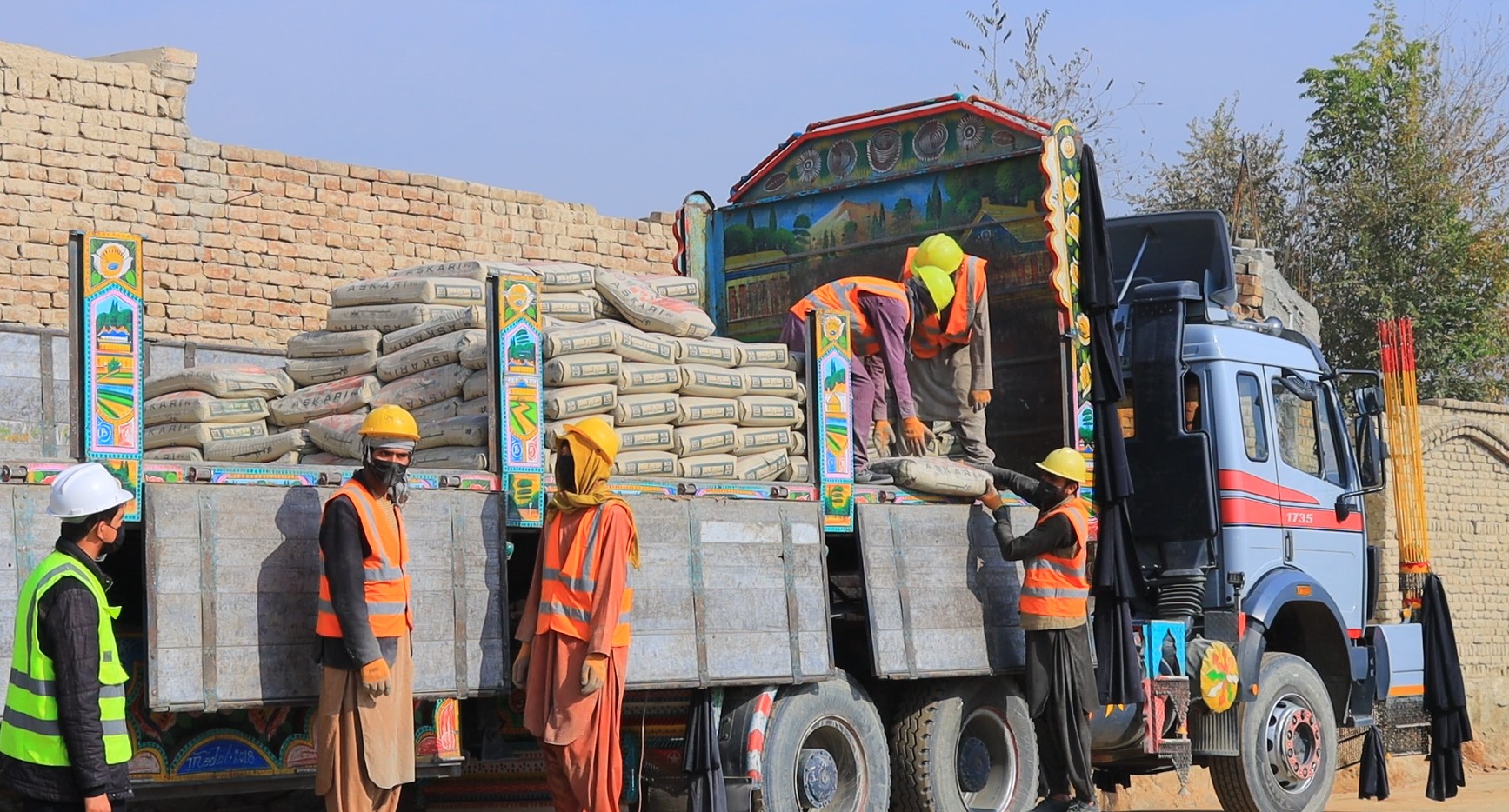
Under the rural component, CRLP partnered with 7 national and international NGOs, which in turn contracted more than 1,000 local suppliers to provide construction materials such as cement, stone, gravel, personal protective equipment (PPE), and tools.
“When construction activities stopped, many small businesses like ours were pushed to the brink. The return of projects like the CRLP did more than restart operations; it restored jobs, revived local markets, and gave businesses the confidence to invest again. Supporting the private sector is essential for rebuilding economic stability.’’
— Jalat Khan, owner of Jalat Khan Ahmadzai Crush Plant, Kabul City
Under the urban component, small-scale subprojects were implemented led by private sector companies. 208 private construction companies were engaged to deliver road upgrades, drainage canals, protection walls, parks and greenery. These firms further relied on local supply networks for materials and services, multiplying the project’s economic impact. In a context where uncertainty remains high, CRLP provided a predictable demand that helped firms retain workers, stabilize operations, and maintain market presence.
“Before the UNOPS project, our workforce had dropped to 12 people. With the increase in construction activities, demand for our services grew and we expanded to 40 employees, including women, while delivering multiple subprojects in Herat.”
— Eng. Maysam Jahid, Safi Ghani Construction Company, District 12, Herat City
As part of its private sector engagement, the CRLP has partnered with the Afghanistan International Bank (AIB) to pilot digital payments for laborers and social grant beneficiaries. Through this collaboration, CRLP is bringing formal banking services to marginalized communities with limited access to financial institutions, introducing beneficiaries to secure digital payment systems and basic banking tools. Beneficiaries receive bank cards which are credited with their wages. They can choose when and where to withdraw funds through AIB’s national network. While payments are linked to short-term livelihood activities, this initiative promotes financial inclusion, improves payment accuracy and efficiency, reduces reliance on cash handling, and strengthens linkages between vulnerable communities and the formal banking sector. As AIB strengthens its banking network, CRLP beneficiaries will be able to participate in e-wallet transactions through Point of Sale (POS) machines in retail and wholesale shops.
At the aggregate level, CRLP’s engagement of private companies and suppliers across multiple provinces has contributed to more resilient local markets, reduced business closures, and supported economic self-reliance.

Laborers unload cement supplied by a local private contractor for a CRLP subproject, supporting local businesses, creating jobs, and strengthening market linkages. @UNOPS/Rafiullah Hemat
-
Basic services as an Enabler for private sector growth
Poor infrastructure remains one of the most significant constraints to private sector growth in Afghanistan. Damaged roads, inadequate drainage, unreliable water supply, and unsafe public spaces increase transaction costs, disrupt supply chains, and limit customer access particularly for small and informal businesses. CRLP investments directly address these constraints.
2.1 Road connectivity to ease access to market
Over the last three years, 400 KM of roads have been rehabilitated/ constructed in urban areas. The rehabilitation of community roads, streets, sidewalks, and market-places improved physical connectivity between producers, suppliers, and consumers. For many businesses, this translated into tangible gains:
-
Reduced transport costs
-
Increased customer footfall
-
Shorter travel times for goods and workers
-
Improved safety and predictability of access
As one shop owner in Kabul explained:
“Before the road was rehabilitated, customers rarely came here, and during the rainy season it became almost impossible for anyone to reach our shop. Many days we had goods but no buyers, and our income was very uncertain. Since the road was fixed, people can travel easily in all seasons, more customers come regularly, and our business has finally become stable.”
— Muhammad Gul, Kabul
By reconnecting businesses to markets, CRLP helped transform infrastructure from a constraint into a catalyst for economic activity.
2.2 Water Systems Restoring Livelihoods and Building Climate Resilience
Reliable water access is essential for agriculture, food processing, livestock, and many home-based enterprises in rural communities. Climate-related shocks, droughts, floods, and extreme heat have repeatedly disrupted livelihoods and undermined business resilience across Afghanistan.
Through the construction and rehabilitation of irrigation canals, water reservoirs, drainage systems, and flood protection structures, CRLP strengthened climate resilience while strengthening productive economic activity. These investments helped:
-
Extend agricultural growing seasons
-
Increase crop yields and surplus for market sale
-
Reduce income losses from floods and water shortages
A farmer from Wardak Province noted:
“Before we had reliable water, our crops often failed, and some seasons we could not grow vegetables at all. We lost income and struggled to support our families. Now, with a steady water supply, I can grow more vegetables throughout the year and sell them regularly at the market, which has greatly improved our livelihood.”
— Azizullah, Wardak Province
Such outcomes illustrate how basic services and economic productivity are deeply interconnected.
-
Why Private Sector Development Matters for Women
Women play a critical role in Afghanistan’s informal and small-scale economy as traders, producers, and service providers yet they face disproportionate barriers to economic participation. These barriers include the various restrictions and bans on women by the DfA which have limited access to marketplaces, customers and supply chains. As a result, women owned businesses are often smaller, more vulnerable, and more likely to close during economic shocks.
By improving basic services, CRLP adopts a principled and inclusive approach that incorporates the needs of women in addressing some of the structural barriers facing women in Afghanistan. Investments in neighborhood roads, walkways, drainage systems, water supply, and public spaces reduce the physical and social risks that often prevent women from participating in economic activity. Improved road conditions and pedestrian pathways shorten travel times, lower transport costs, and make daily movement safer and more predictable. Reliable water and services support home-based and small-scale enterprises such as livestock rearing, poultry farming, and kitchen gardening that are commonly managed by women and form a critical part of household livelihoods in rural communities of Afghanistan.
Through inclusive planning processes and community engagement, the project ensures that women’s needs and usage patterns are reflected in subproject selection and design. By improving access to basic services, CRLP creates enabling conditions for women-owned and women-led businesses to survive, adapt, and grow, elevating basic service delivery into a foundation for sustainable and inclusive private sector development.
Beyond basic services, CRLP provides direct livelihood support to vulnerable households through Social Grants (SGs). To date, more than 182,520 households have received grants, of which 56.9 percent are women-headed households. These grants help reduce negative coping strategies, and support small-scale economic activities.
In addition, CRLP has introduced targeted livelihood initiatives for women, piloting poultry farming in the first year. Through these interventions, women received practical training and start up kits. These home-based enterprises allow women to:
-
Improve household food security
-
Improve household nutrition by including eggs and chicken to their diets
-
Generate independent income from the sell of eggs
-
Participate in local economies within existing social and mobility constraints
By supporting women’s productive roles at the household and community level, CRLP strengthens both economic inclusion and resilience.

A beneficiary engaged in poultry farming as part of an economic activity in Wardak Province. @UNOPS/Rafiullah Hemat
-
Employment Creation and Local Economic Recovery
CRLP investments generate layered economic impacts. In the short term, construction and rehabilitation works create employment through CfW, prioritizing local labor and engaging women where feasible. In the longer term, improved infrastructure revitalizes local economies by enabling businesses to grow, trade, and adapt to climate risk. In rural areas, CRLP has generated employment for 910 Engineers, 910 Male Social Organizers, and 910 Female Social Organizers via project facilitating partners. In urban areas, the project created approximately 4,355 job opportunities for contractor staff (including 1,222 for women) for an average duration of 3 to 5 months who were directly involved in sub-project implementations including qualified personnel such as Project Managers, Quality Control Engineers, HSSE Officers and Social Organizers.
Conclusion
By deliberately engaging private construction firms, local suppliers, and community-based enterprises, CRLP ensures that recovery is not driven solely by external assistance, but by Afghan businesses themselves.
“Through the plum concrete streets, we are relieved for a longer time from the challenges of winter.”
— Ahmad, a resident of District 8 of Kabul City
CRLP demonstrates that private sector development in fragile contexts is not separate from service delivery. When roads connect entrepreneurs to markets, when water systems protect livelihoods from climate shocks, and when women can safely run businesses close to home, local economies begin to recover.

A newly constructed road in front of shops and houses in Kabul City, making it easier for community members to move safely during winter and dusty conditions. @UNOPS/Rafiullah Hemat
×
![]()